
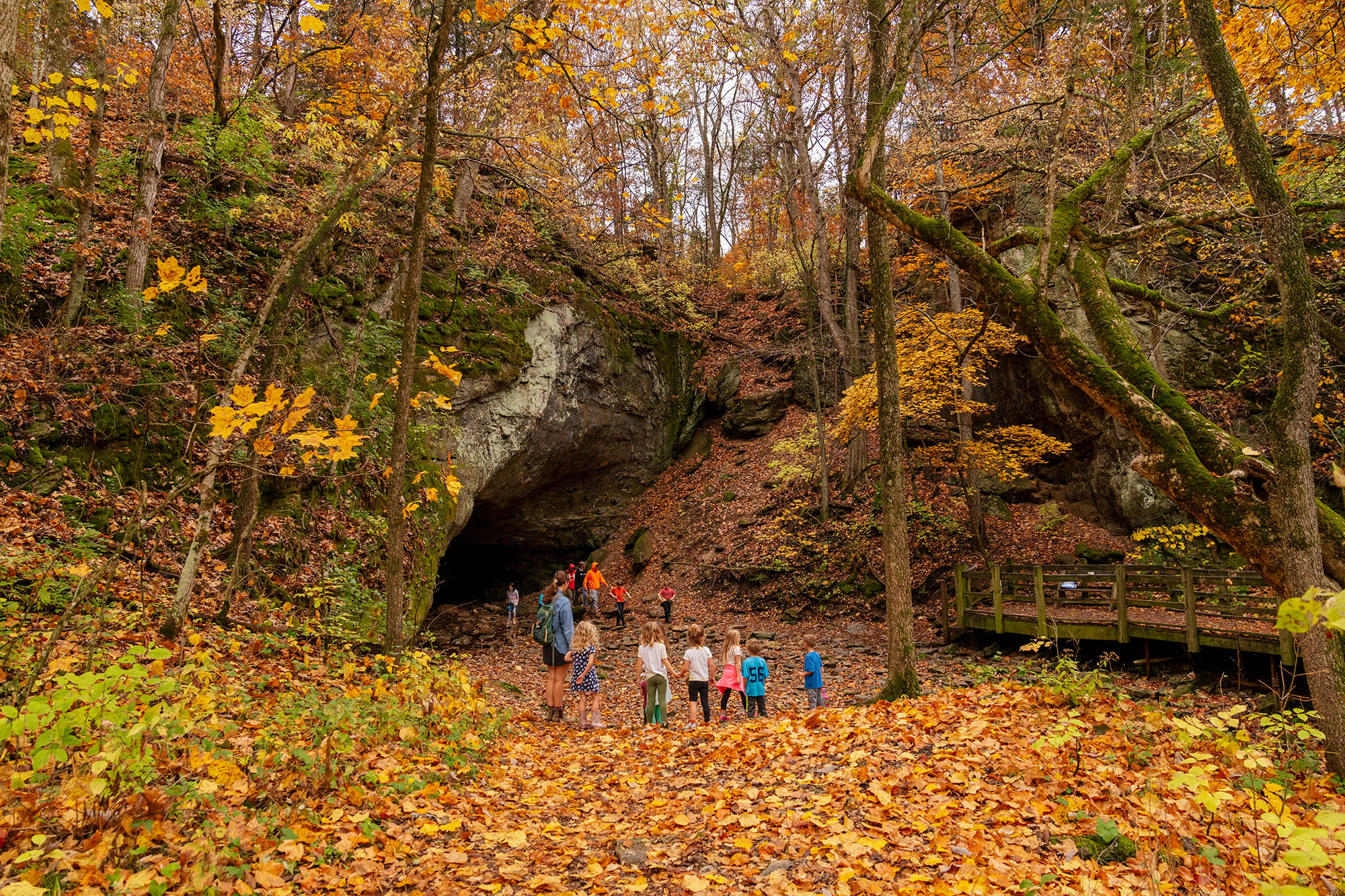
Rock Bridge Memorial State Park in Columbia offers exciting views for visitors year round. MoDNR photo by Adam Knaebel.
For more than four decades, Missouri’s residents and visitors have benefited from free entry into one of the country’s top-ranked state park systems, a privilege almost unheard of in other states. Missourians have also witnessed a dramatic reversal of the state’s once-severe soil erosion problem. These successes directly result from a small but mighty state constitutional measure: the Missouri Parks, Soils and Water Sales Tax.
A Small Tax with Monumental Return
First approved by voters in 1984, this dedicated one-tenth-of-one-percent sales tax is an impressive example of Missourians choosing to invest in their state. Revenue from the tax is split, with half dedicated to the Missouri Department of Natural Resources’ Division of State Parks and the rest going to the Soil and Water Conservation Program.
This small individual investment yields massive returns. The parks portion of the tax provides about 75% of the division’s budget, covering vital operations, maintenance and improvements. Missouri is one of only eight states that provide free admission – a point of envy for many other states, where entrance fees can easily cost $10 or more per person for a daily visit.
The benefit to all Missourians and visitors alike is the unmatched accessibility to Missouri’s 93 state parks and historic sites.
“Missouri’s state parks and historic sites highlight amazing outdoor spaces and locations of importance to our state’s history and culture,” said Stephen Foutes, the director of the Missouri Division of Tourism. “To offer residents and out-of-state travelers the opportunity to explore these locations with no general admission, and to enjoy guided tours at others for a very modest or no fee, gains Missouri the admiration of many states.”
Missouri state parks and historic sites receive an estimated 19 million visitors, including 1.3 million overnight guests annually. This influx creates a multiplier effect, as visitors spend money locally on essentials like gas, food and lodging, transforming the tourism economy into resource stewardship investment. Beyond recreation, Missouri state parks and historic sites function as vital economic hubs, providing public services such as drinking water, wastewater, road maintenance and sanitation, much like small towns.
The Other Half
The department’s Soil and Water Conservation Program, also primarily funded by the sales tax, provides financial incentives and cost-share assistance to landowners and farmers across the state’s 114 soil and water conservation districts. This program supports qualified voluntary conservation practices, including:
- Erosion control: Provides funding for structural solutions like terraces, grassed waterways and sediment basins to keep valuable topsoil on the fields.
- Water quality: Assists with nutrient and pesticide management, as well as proper animal waste management to protect rivers and streams from contaminated runoff.
- Land productivity: Encourages farmers to use planned grazing systems and permanent vegetative covers to enhance agricultural land health and sustainability.
These efforts have successfully pulled Missouri back from once having some of the highest erosion rates in the nation.
“Since 1984, the Parks, Soils and Water Sales Tax has served all of Missouri by conserving and protecting our soil and water through cost-share assistance,” said Missouri Farm Bureau President Garrett Hawkins. “These programs, administered by local soil and water conservation districts, have supported 295,000 practices on farms across the state, resulting in 194 million tons of soil saved since inception.
“Every 10 years, voters have reaffirmed their support for these initiatives, making Missouri a national leader in locally led conservation and ensuring our soil and water resources are preserved for the next generation.”

The Tax’s History
Prior to the sales tax, the Division of State Parks and the soil and water conservation districts faced federal and state funding cuts. In response, the department constructed gated entrances at parks and began selling admission passes. The public disapproved, which led to the Missouri Parks Association’s formation in 1982. The association worked with other organizations, such as Missouri Farm Bureau and the Conservation Federation of Missouri, to seek alternative funding sources.
On Aug. 7, 1984, voters approved the Conservation Sales Tax, also known as Missouri Issue 1, by a narrow 50.1% on the primary election ballot. The tax levied an additional one-tenth of one percent sales tax, split evenly between state parks operation and maintenance, and soil and water conservation efforts. This initiative expired five years after its first adoption. Initially, there was confusion about the tax’s name, with some voters mistaking it for the Missouri Department of Conservation’s existing constitutional tax.
In 1988, one year before the sales tax expired, the Missouri Parks Association, Missouri Farm Bureau and the Conservation Federation of Missouri once again met, and through their work, collected 300,000 signatures from voters to get the Missouri Tax Extension for Parks Amendment (Amendment 7) onto the Nov. 8, 1988, ballot. This measure proposed extending the tax for 10 years and allowed revenues from the tax to be used for soil and water conservation as well as for state parks. Once again, the tax was approved, this time by 68.66% of voters.
“The Parks, Soils and Water Sales Tax is the backbone of the Missouri state park system, preserving the campgrounds, trails and natural spaces that generations of families rely on,” said Tyler Schwartz, executive director of the Conservation Federation of Missouri. “Protecting these outdoor recreation opportunities is vital to ensuring every Missourian can continue to explore, learn and find belonging in our shared outdoors.”
The sales tax’s significance was realized during the 1990 financial crisis, when Missouri state parks and historic sites lost $9 million of general revenue funding. Historically, this covered basic operating costs, and staff salaries and benefits. Since then, the department has not received any general revenue funding for park operations, which emphasizes just how important the sales tax is to help fund its operations.
In 1996, a statewide initiative petition passed, automatically adding the tax to the ballot every 10 years. The Missouri Conservation Tax Amendment, also known as Amendment 8, was approved with 66.61% of voters in support of extending the tax for soil and water conservation, as well as for acquiring, developing, maintaining and operating state parks and historic sites.
The first automatic renewal vote under this amendment was Aug. 8, 2006. Nearly 71% of Missouri voters approved it.


In 2016, the Missouri Parks, Soils and Water Sales Tax, or Constitutional Amendment 1, passed with 80% statewide approval. This was the first time it was approved in all 114 counties and the city of St. Louis.
Today, the Parks, Soils and Water Sales Tax remains the main funding source for Missouri’s 93 state parks and historic sites, providing 75% of their budget, with the other 25% coming from other earnings and federal funds. In fiscal year 2024, the sales tax generated $68.5 million in funding. The portion of the tax that supports the division averages about $10 per Missourian, per year.
“Forty-two years ago, Missouri citizens made a remarkable commitment to protecting our natural heritage by passing the Missouri Parks, Soils and Water Sales Tax,” said Kendra Varns Wallis, executive director of the Missouri Parks Association. “Since then, voters have reaffirmed that dedication every time it’s appeared on the ballot. This small investment delivers enormous benefits – preserving our state parks, conserving our soils and waterways, and ensuring every Missourian can enjoy free access to some of the finest parks in the nation.”
In essence, the Parks, Soils and Water Sales Tax is citizen driven. For the equivalent of a few dollars a year, Missourians gain free, high-quality access to the outdoors, while simultaneously funding the fundamental soil and water conservation work that sustains the state’s environment and economy. Its passage affirms that a small investment can yield monumental results for the Show-Me State.
Read more about Missouri’s Parks, Soils and Water Sales Tax on the MoDNR website.