
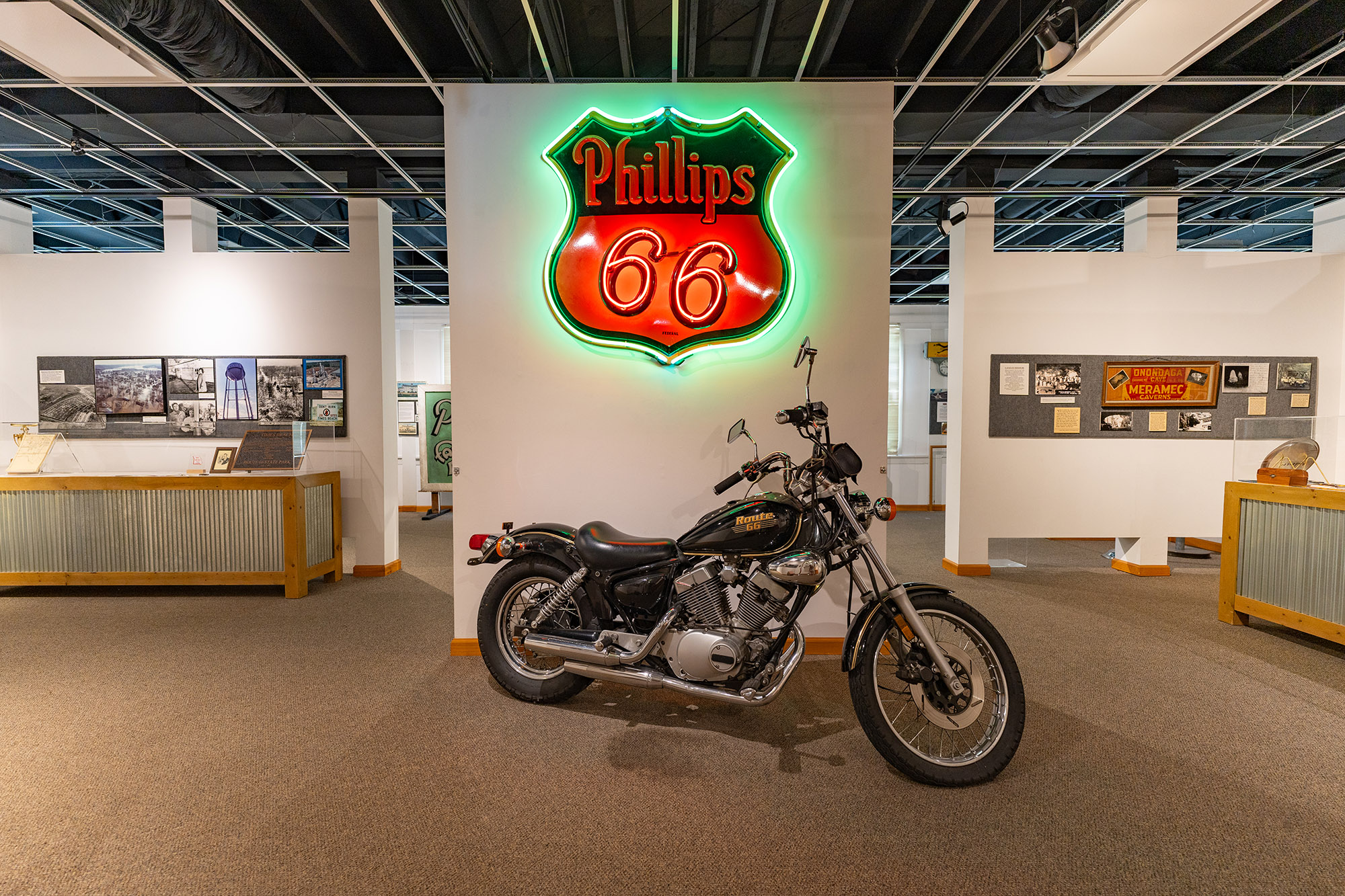
At Route 66 State Park, visitors can view vintage neon signage, a classic motorcycle and more at the park’s visitor center. MoDNR photo by Adam Knaebel.
Americans can be a nostalgic and sentimental bunch of folks. If you need evidence, just consider our fond memories of first loves, how we pass down family recipes and the stories behind our old, tattered black-and-white photos.
It is little wonder that many of us – and countless others around the world – are celebrating the birthday of a highway. Mind you, we’re not talking about just any ribbon of concrete or jubilee. To the contrary, 2026 marks the 100th anniversary of the nation’s most cherished and famed roadway: U.S. Route 66.
Many folks tend to think of Route 66 stretching only through dramatic desert landscapes. This is attributed to the impressions provided by films such as Cars, The Grapes of Wrath and Easy Rider, as well as TV shows like Route 66, all of which are set primarily in the roadway’s western stretches. It is important to note, however, that the Show-Me State holds a special place in history as the actual birthplace of the road.
In the mid-1920s, Cyrus Avery and John T. Woodruff gathered a small group of business owners to lobby for a new federal highway stretching from Chicago, Illinois, to Santa Monica, California.


Avery, who spent more than 20 years living in Missouri, was highway commissioner for the state of Oklahoma, and Woodruff was an attorney in Springfield, where the concept for the highway was hatched. On April 30, 1926, after much negotiation, Avery, along with Missouri Highway Commission engineer A.H. Piepmeier, sent a telegram from Springfield, on behalf of the gathered group of highway officials, proposing the road’s official name.
It might surprise you to learn that from 1926 until 1932, Route 66 passed through the greater St. Louis communities of Maplewood, Brentwood, Rock Hill, Kirkwood, Des Peres, Manchester, Ballwin, Wildwood and Gray Summit. Later, the road’s path was changed to bypass St. Louis through Hazelwood, Bridgeton, Maryland Heights and Creve Coeur.
While much of historic Route 66 was lost to progress or neglect, you can still enjoy numerous scattered segments today.
Largely located in rural communities and sparsely populated areas, some of the old road is not only visible but can still be enjoyed as part of your journey. In fact, some people make their livelihood by catering to those who treasure all things having to do with the “Mother Road.”
Of particular interest to true Route 66 afficionados is the wide array of unique and charming businesses that sprang up through the years to accommodate weary travelers. Many of the structures and some of the actual businesses survive to this day.
The Bridgehead Inn, a roadhouse built in 1935 in what was formerly known as Times Beach, was known for its marvelous food. The business later operated as Steiny’s Inn and then Galley West. It closed when extensive dioxin contamination shuttered the entire community in the early 1980s, and the town’s population was relocated due to historic flooding.
After the land of Times Beach, in St. Louis County near the city of Eureka, was remediated, it was transferred to the Missouri Department of Natural Resources and repurposed as Route 66 State Park. The former inn building now serves as the park’s visitor center, gift shop and staff offices.
Much of the park cannot be reached directly from the visitor center. Instead, visitors must follow nearby I-44 two exits to the west, then turn around and come back one exit to the east. The convoluted route is due to the closing of the old Route 66 bridge over the Meramec River because of safety concerns.
Long the focus of Route 66 preservationists, the old bridge will one day get reborn when new structural steel and a fresh deck are applied. When complete, it will finally reestablish a direct vehicular route from the visitor center to the rest of the park.
Modern day I-44 closely parallels the Mother Road corridor through Missouri. Its path is dotted with several nearby Missouri state parks and historic sites. One should consider a visit when making any Route 66 pilgrimage. Some parks even offer accommodations that were built during the heyday of America’s Main Street.
Happy birthday, Route 66!
For more information, visit the Route 66 State Park webpage.
General Transportation
It is virtually impossible to discuss Route 66 without including the topic of car culture.
Each year, thousands of motorists enjoy exploring the nation via the path of historic Route 66. This is especially true of those who appreciate the visceral thrill of driving vintage automobiles along a roadway that still permeates so many family vacation memories and has spawned countless pop culture touchpoints.
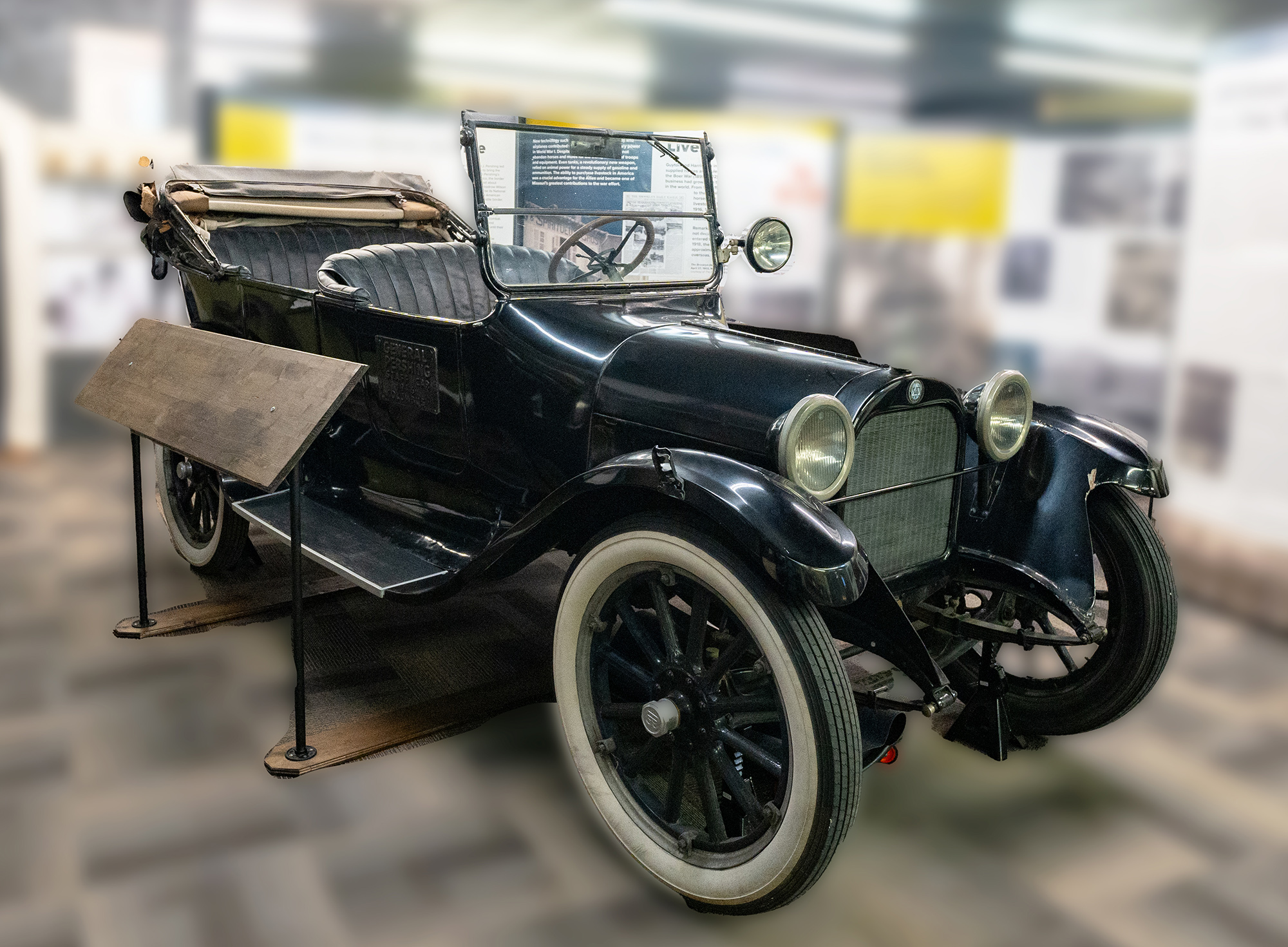
An intriguing automotive artifact was recently donated to the Division of State Parks. The vehicle, a Dodge Brothers touring car reportedly used by General John J. “Black Jack” Pershing, is displayed at the General John J. Pershing Boyhood Home State Historic Site in the town of Laclede in northern Missouri. The residence is currently undergoing a foundation stabilization project and is closed for tours until work is complete, but the new office at the site serves as a museum and interpretive center.
Visitors can also tour the Prairie Mound School where Pershing taught for a year and a memorial garden with a statue of the general. The site’s purpose is to preserve the legacy of this significant Missourian and educate visitors about his life and the community in which he was raised.
For more information, visit the General John J. Perishing Boyhood Home State Historic Site webpage.