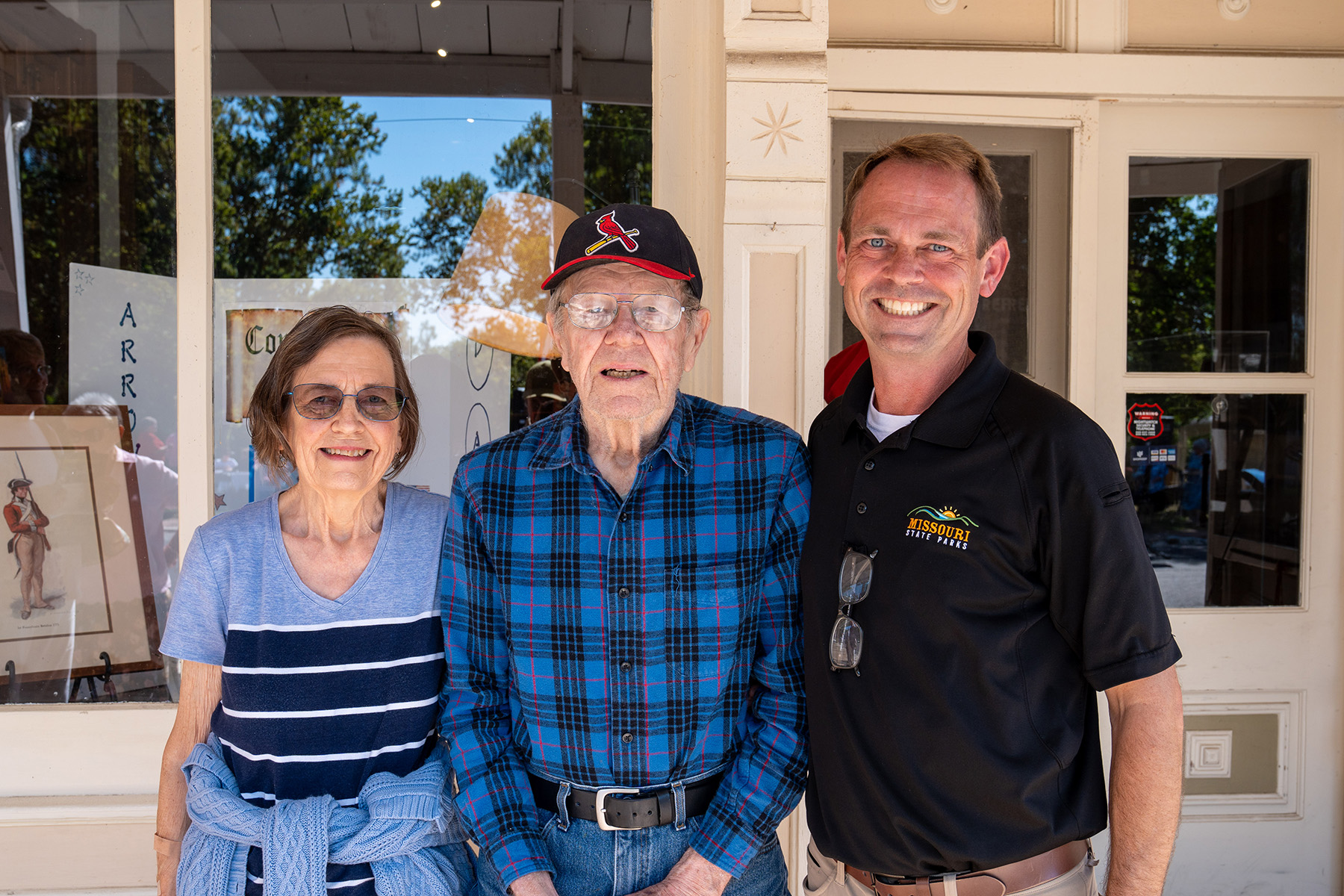
Brian Stith (right) smiles with his mother, Mary (left) and father, Bob (middle) while celebrating the J. Huston Tavern’s 100th year with Missouri State Parks. (MoDNR photo by Adam Knaebel)
Those who interact with the Missouri Department of Natural Resources for the first time may immediately notice a common theme in the team members they meet. They are passionate about Missouri and the environment, and they strive to help citizens, communities and businesses understand the needs and benefits of being good stewards who support the environmental and economic vitality of our state.
Many of these devoted individuals have been passionate a long time, and their history with the department is a testament to that passion.
Family tradition
As a child, Brian Stith’s backyard was a state historic site.
“I grew up on a farm near Arrow Rock, and I think I held every job there was in the town at one point or another. I started out washing dishes and then finally progressed to working as a seasonal tour guide for the Friends of Arrow Rock, from 1988-1992,” he said.
Stith represents the fourth generation of his family to work in, as well as love, Missouri’s state parks and historic sites. His mother, Mary, started working as a seasonal tour guide at Arrow Rock State Historic Site in 1989 and retired in 2006 as an interpretive resource technician. Stith’s sister also worked as an environmental engineer in the department’s Division of Environmental Quality from 1994 until 2004.
Going further back, his paternal grandfather, Bob Stith, served as superintendent of Arrow Rock State Historic Site from 1958 until 1972, while his maternal great-grandfather, Lester Dixon, was the superintendent there from 1943 until 1954.
After receiving a history degree, Stith followed what came naturally and began working full time with Missouri State Parks in 1995. As an assistant historic site administrator at the Missouri State Museum, he was in charge of tours of the Missouri State Capitol. He later shifted to the eastern region of the state park system and became supervisor of the Southern Missouri Historic District. He is now a deputy director at Missouri State Parks.
A love of history and the outdoors, instilled in him as a child, has brought him a long way. But, he hasn’t forgotten his roots.
“My favorite outdoor spot is the Missouri River overlook near the main picnic shelter at Arrow Rock State Historic Site,” Stith said. “It seems as though I spent my entire childhood playing at the nearby playground, walking the trails and exploring the bluffs. There was probably a time I could have navigated those bluff trails with my eyes closed. I realize not everyone has been as fortunate as I have to be exposed to the outdoors all of my life. I thank my family for that.”
For Stith, serving the citizens of Missouri is an ongoing family tradition.
Doing what she should be doing
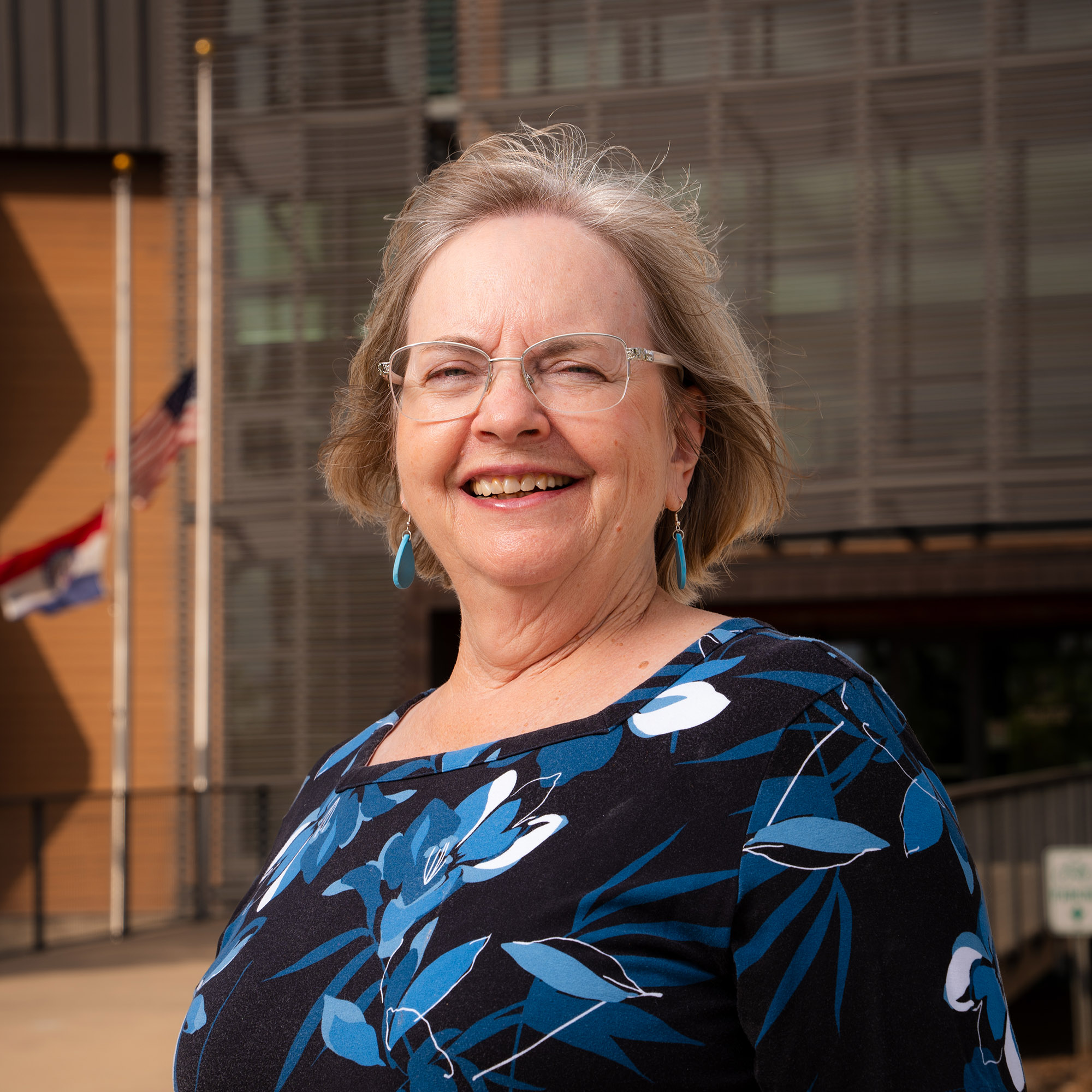
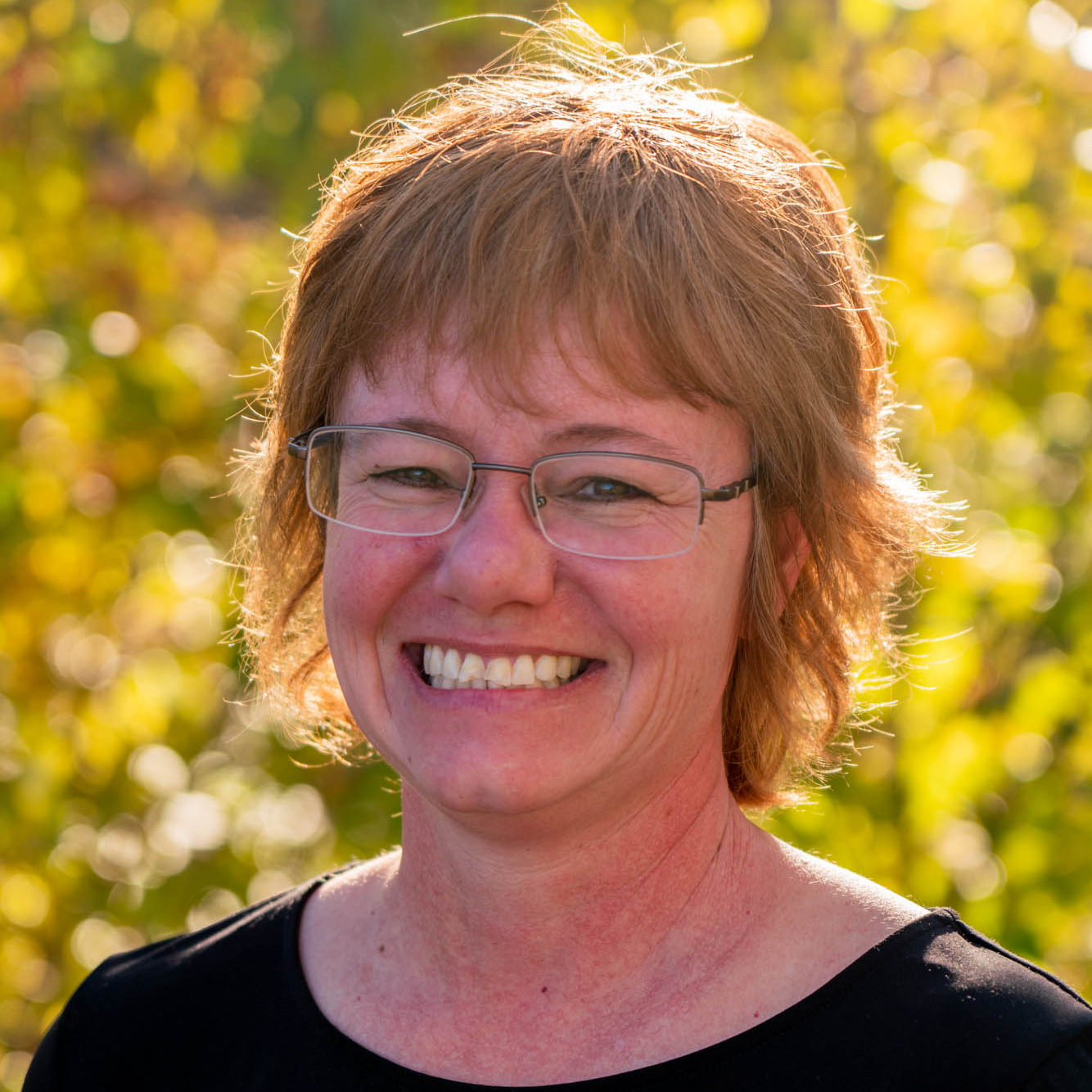
For 49 years, Martha Buschjost has dutifully performed her work, knowing she had a job to do and wanting to do her best. Over the years, she worked her way up from stenographer with the Water Pollution Control Program to the role of administrative assistant for former department director Steve Mahfood. She now enjoys a less-demanding position as a part-time administrative assistant with the Division of Energy.
In talking to Buschjost, it’s clear that her family life has always had to fit into her career and not the other way around. Married at age 30, she spent about a decade in the workforce before having her two kids.
“When my son was born, my mom asked if I couldn’t just take some time off,” Buschjost reminisced. “I said, ‘Mom, if I do that, then I have to start all over,’ which I would have had to, back then.”
Continual advancement is part of what has kept her at MoDNR for so long. “I got promoted from Land Reclamation to the Division of Environmental Quality to the Director’s Office,” she stated. “I always got those opportunities, and I was reluctant to leave the security of state employment.
“I think there is worth in all of the department’s work,” she observed. “The Division of Energy has been moved between a few different agencies over the years, but I’m glad we’re back with MoDNR. I think the division can do a lot of good work, and with the funding that’s coming up, I’m hoping that will happen.”
While she enjoys working for the Division of Energy, her daughter keeps asking when she plans to retire. Buschjost quipped, “Well, right now, the money’s pretty good! I’m also not a stay-at-home person. I could keep myself busy, but I’m kind of afraid that I won’t. I would be sitting around not doing what I should be doing.”
As she looks to the future, Buschjost believes she is exactly where she should be, doing exactly what she wants to be doing.
A calling of peculiar dignity
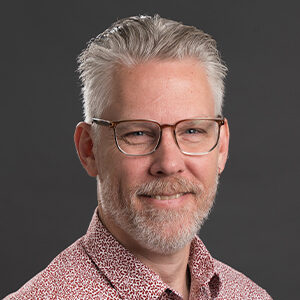
What began as a love for rocks at just age 5 turned into a 56-year career. Art Hebrank started with the Missouri Geological Survey in 1967, predating the Missouri Department of Natural Resources by seven years.
“I started working at the Missouri Geological Survey in subsurface topography and later became the unofficial mineral information/educational specialist. I was the curator of collections, keeping track of 50,000 books and 150,000 maps. I helped with field trips and eventually turned into the official question answerer and mineral and rock identifier,” Hebrank said with a laugh.
Hebrank’s demeanor and personality make him a perfect fit for his position. He loves to answer questions and to share his knowledge with others.
“I like public service; it feels good to make a difference year after year after year,” he said. “The rewards are immediate, especially when you see someone leave with answers to their questions. Kids especially get really excited. And it’s a great learning experience for me, as well. No matter how much time I’ve spent thinking about questions and answers, someone will come up with one, and I’ll think, now where did that come from?”
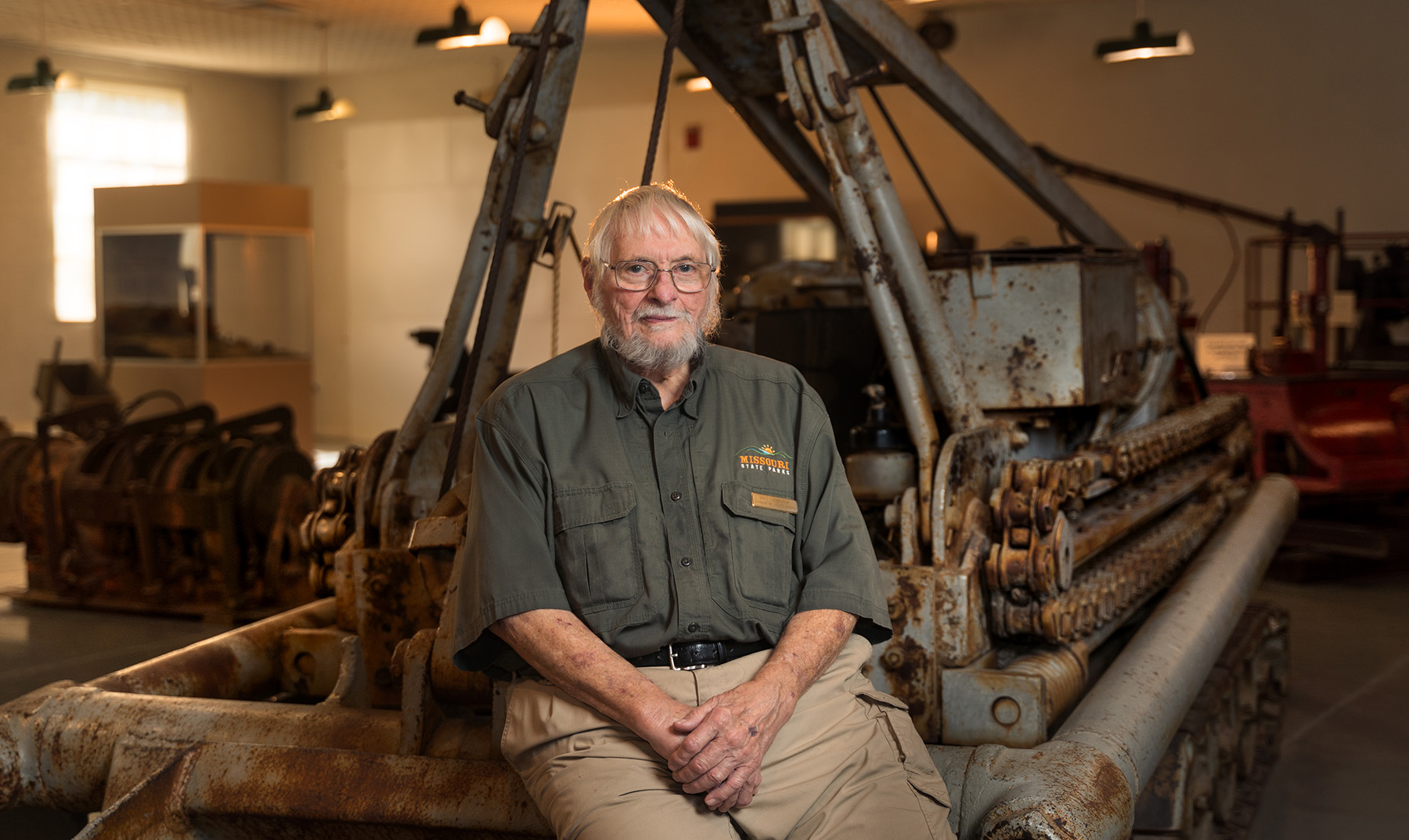
Hebrank says his greatest accomplishment has been presenting workshops for teachers wanting to incorporate earth science into their curricula. He estimates he gives six to eight workshops yearly, with 30 teachers in each. Over the course of 30 years, he said he taught at least 5,000 teachers, not to mention the trickle-down effect to the students.
Not only does he know his rocks and minerals, he has a background in mining as well. After spending a summer working in a silver mine in Idaho, Hebrank’s appreciation for mines grew. Years later, when a position at Missouri Mines State Historic Site opened, he made the move. He has hopes to see the museum redone, which is the project he is working on now.
“I think this museum should be a chronological walk through time. I’ve never come across a museum like that, but I hope to make this into one before I leave,” he said. “I want to show visitors the importance of the mining industry and miners who followed this calling of peculiar dignity.”
If you’re interested in a career with the Missouri Department of Natural Resources, visit dnr.mo.gov/careers.