
Imagine returning home after a long vacation only to find your house is no longer there! That’s exactly what happened to some Indiana bats that had used Locust Creek Covered Bridge as their summer home.
In late February, Missouri State Parks moved Locust Creek Covered Bridge from its original location in Laclede to its new home at Pershing State Park, about five miles away. According to Brett Barnes, deputy regional director with Missouri State Parks, the 157-year-old bridge was in danger of being damaged beyond repair by flooding in the problematic watershed if decisive actions were not taken to move and preserve it.
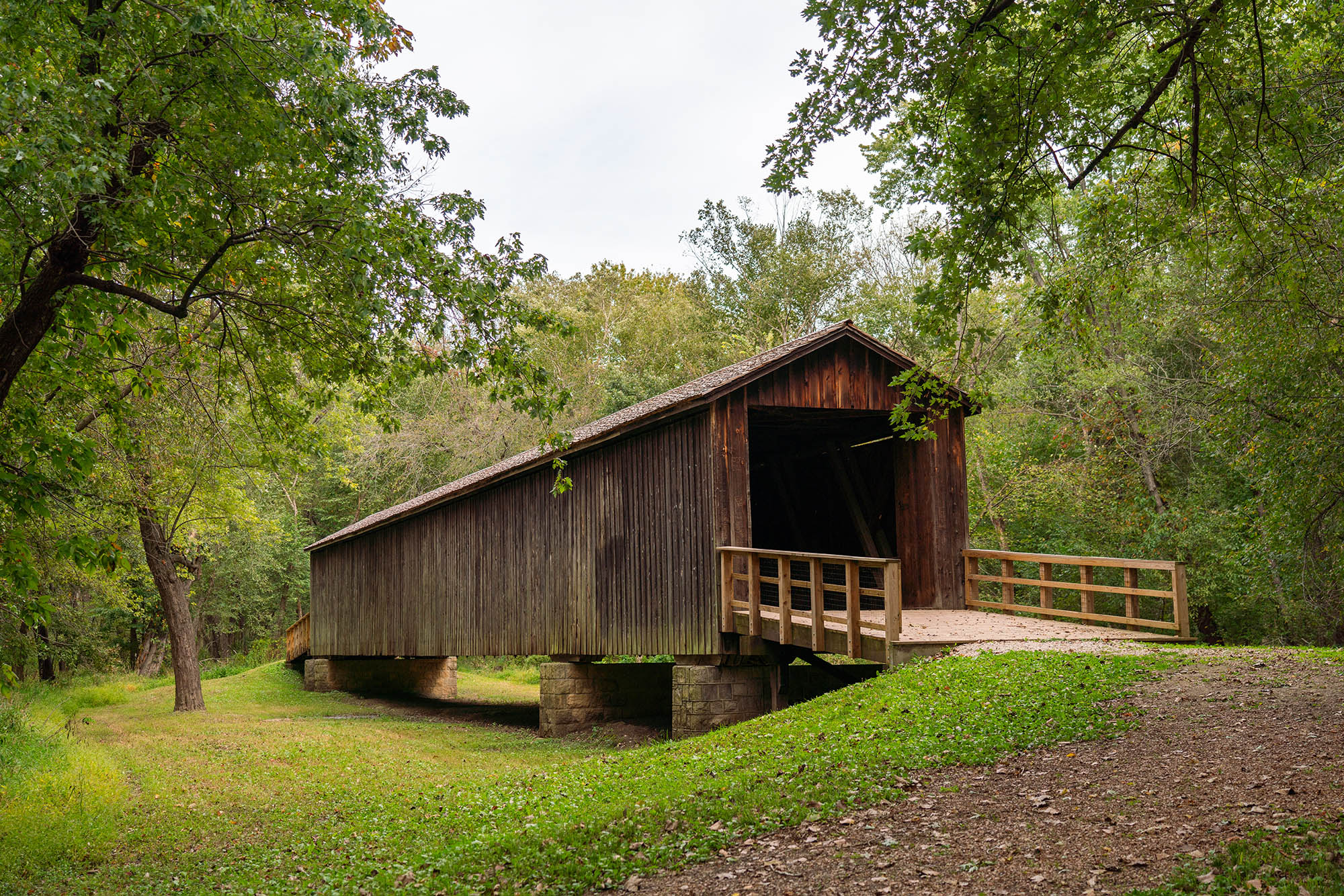
Built in 1868, the 151-foot bridge was once an important link over Locust Creek on America’s first transcontinental road, Route 8. After World War I, gas-powered vehicles gradually replaced horse-drawn wagons and buggies, and in 1930, U.S. Highway 36 replaced Route 8, making Locust Creek Covered Bridge less important to area travel.
Over time, Locust Creek’s channel shifted away from the bridge, effectively stranding it over land.
“The channel moved away from the bridge due to natural meandering,” said Ken McCarty, the recently retired director of the Natural Resources Management Program with Missouri State Parks. “Once the bridge’s channel segment migrated eastward, that original channel and the floodplain itself filled with flood-borne sediments. The floodplain’s elevation raised year by year, burying the original bridge piers at least 14 feet below the current ground surface.”
This left the bridge sitting isolated and vulnerable within a wide forested bottom between the modern, logjam-prone creek to the east and the unstable, flood-carved banks of Higgin’s Ditch to the west.
So, what does this have to do with bats? The Indiana bats, a federally endangered species, normally don’t roost in structures, but it can and did happen here! Many years ago, Locust Creek Covered Bridge became home to a summer maternity colony of Indiana bats. In 2024, experts confirmed it to be the largest maternal colony yet discovered in Missouri.
The Indiana bat is a small, insectivorous, migratory bat species that usually hibernates in caves and mines during the winter. A large hibernating population exists in a mine near Hannibal. In spring, the bats disperse to maternity sites scattered across north Missouri and adjacent states. The summer colonies tend to be small, usually settle in dead trees near open areas and return every year. In existence for decades, the Locust Creek Covered Bridge maternal colony numbers more than 300 individuals.
“This is a unique situation,” said McCarty. “This is Missouri’s largest known maternity colony. After hibernation, the bats at the Hannibal mine site leave at an individual pace and return to raise their young at Locust Creek Covered Bridge. They have developed a cohesive colony that they have maintained year after year for at least several bat generations.”
Carrie Stephen, natural resource ecologist with Missouri State Parks, assisted Indiana bat expert Vona Kuczynska of the U.S. Fish and Wildlife Service to count the bats at the bridge. The first step was to use a sound detector to verify the bats were Indiana bats.
“Then, we closed off one side of the bridge and used nose counts with an infrared and thermal imager, along with photos, to determine how large the colony was. We figured we undercounted at 318 bats. This maternity colony is where the females come to raise their pups,” Stephen said.
“They all cluster in tight groups, scattered in the deepest shadows,” McCarty said. “Being so tiny and tightly packed, it’s hard to see or count them all without the thermal imaging and ultrasonic detection technology. So, for years we have known they used the cave, but had no idea of the true number or that the covered bridge would prove to house Missouri’s largest known maternity concentration.”


Stephen and McCarty, in partnership with the U.S. Fish and Wildlife Ecological Services’ field office in Columbia and with technical advice from the Missouri Department of Conservation, worked diligently to find an alternate home for the bat colony after Missouri State Parks determined the historic bridge needed to be moved.
“It’s been a journey figuring everything out and operating in a short timeframe,” said Stephen. “We knew time was of the essence, not only for the bridge’s safety and integrity, but also for the colony’s return.”
Stephen and McCarty worked together to brainstorm solutions and settled on
a final resolution.
“We didn’t want to lose the colony,” McCarty said. “The bridge’s new location would be just outside of the bat’s normal foraging range, meaning a good possibility the first returning bats wouldn’t find it, then fly off looking for another location, and the colony that has persisted for decades would fragment and be lost. This really is a big deal as we don’t want to lose a colony of this size or the critical maternity opportunity that the riparian bottoms in Pershing State Park have provided at this specific location.”
After much research, the team contacted Copperhead Environmental Consulting. The company makes BrandenBark™, a unique artificial roost structure that provides bats with alternative roosting opportunities – basically synthetic bark attached to a utility pole to mimic a tree.
Copperhead Environmental Consulting has researched Indiana bats and knows they do use these structures in other locations. Missouri State Parks has installed some of these structures where Locust Creek Covered Bridge was located and in a few other locations nearby.
“The artificial peeling bark attaches to the pole and instead of the bats living in the bridge, we hope they will use the new roosting structures or find a dead tree where the bark is sloughing off. A lot of bats can fit in exfoliating bark,” Stephen said.
The solution must be situated near water and among trees that allow the bats a clear flyway. The field near Higgins Ditch is an ideal location according to McCarty.
Now that the covered bridge is moved, and the roosting structures are in place, Stephen said Missouri State Parks will monitor the location to see if the bats move to the new structures.
“We hope the bats come back and make their homes in the dead trees or in the alternative structures,” McCarty said. “We hated to move the bridge, but if we didn’t, that piece of history would be lost forever.”
Plan your visit to Locust Creek Covered Bridge at its new location within Pershing State Park by visiting mostateparks.com.