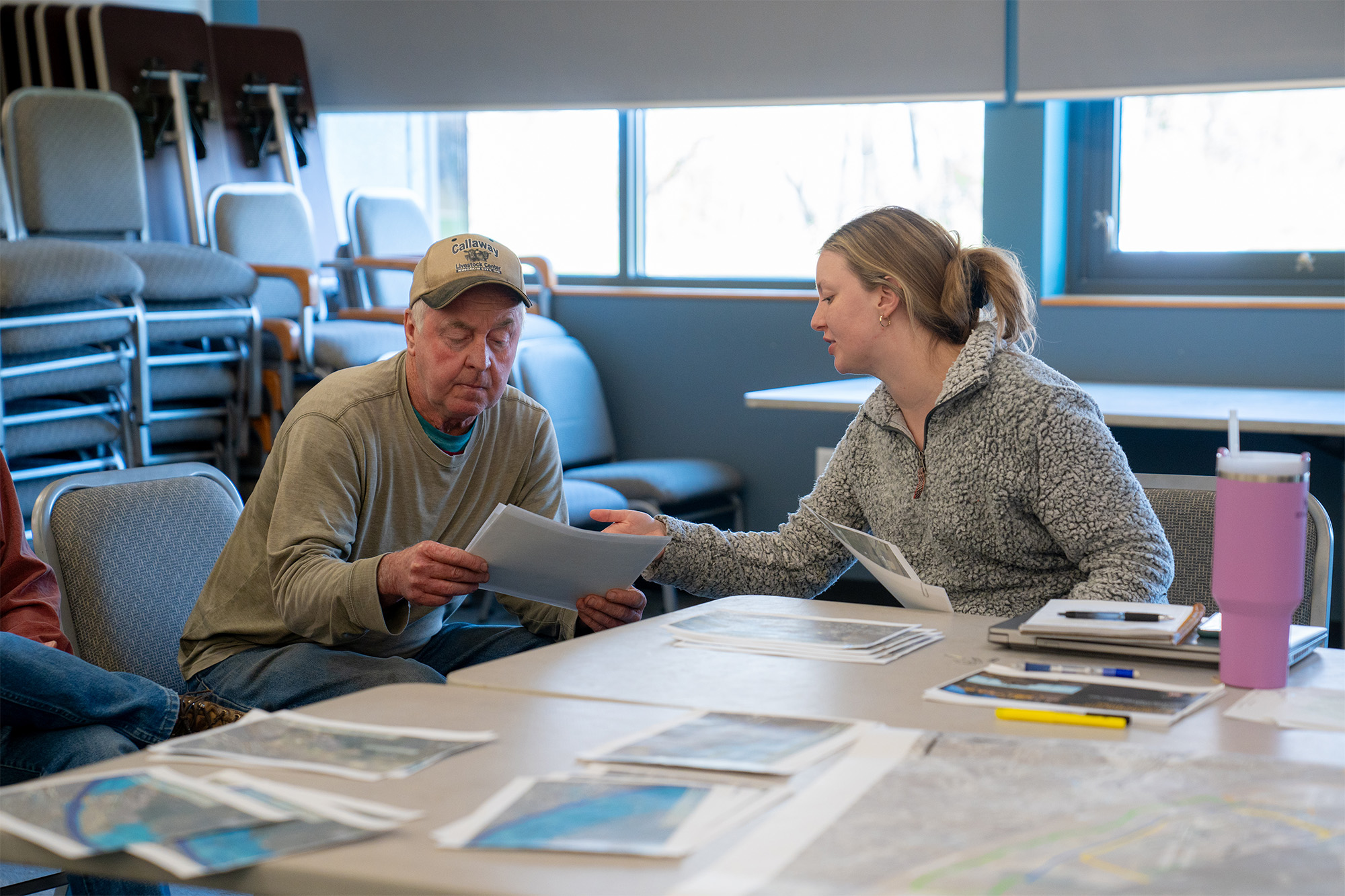
Elizabeth Kerby answers questions about flood mitigation related to concerns from a member of the public.
When you hear the term natural resources, your mind may conjure images of sunlight filtered through the canopy of a wooded forest or deep, blue-green water winding through a bend in your favorite float trip river. It’s unlikely that you would think of equations for air quality index calculations or the velocity-area method for water flow.
However, such formulas are essential for people who work in natural resources engineering. Engineers, professionals who are tasked with understanding and applying those concepts, bring a valuable skillset to the work the Missouri Department of Natural Resources does each day.
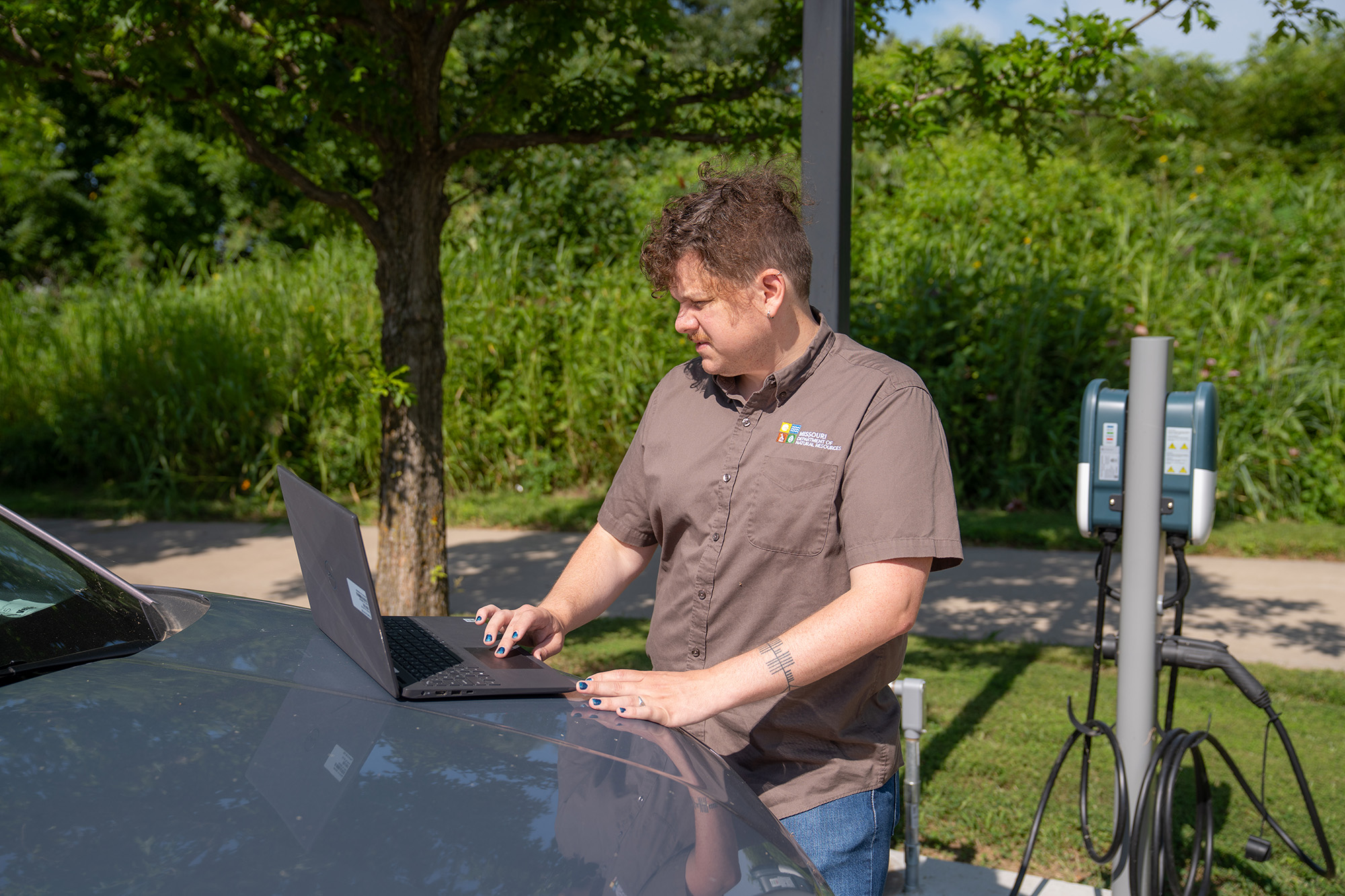
Energy engineer Wes Fitzgibbons came to MoDNR while looking for a career shakeup.
“I started in the department’s Air Pollution Control Program as it was administering Missouri’s share of federal Volkswagen Trust funding, applying transportation-related solutions to improve air quality,” Fitzgibbons said. “As the program was winding down, I had the opportunity to move to the Division of Energy, where part of my work involves electric vehicle infrastructure planning.”
Among Fitzgibbons’ successes are establishing numerous charging stations at strategic points across the state and a new charging station
for state-owned EVs.
Elizabeth Kerby is an assistant engineer with the Missouri Geological Survey’s Water Resources Center. Working to become a professional engineer, Kerby is in the process of completing four years of engineering experience, after which she will take the Principles and Practice of Engineering exam.
“The most challenging work I have handled as an assistant engineer is the Lower Missouri River Flood Risk and Resiliency Studies project,” said Kerby. “I am usually on the technical side of projects. With this one, I had to flex my soft skills in creating an environment where stakeholders felt safe to share information, and the community could work through differing viewpoints on the project. I am lucky to have great leadership to develop my skills in negotiation, strategic thinking and effective communication.”
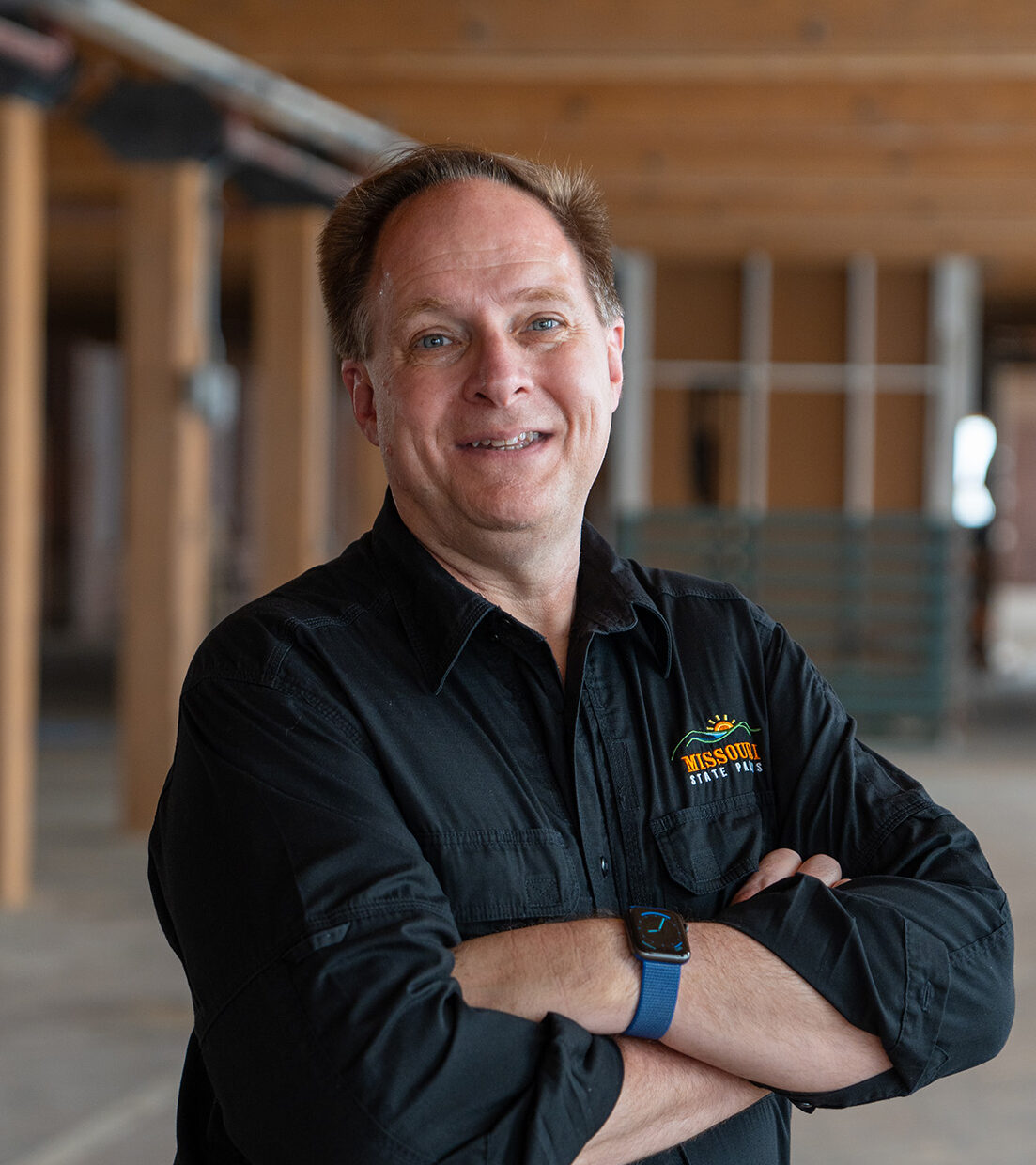
Terry Bruns joined Missouri State Parks in 2021 after working hand-in-hand with division staff while serving as an engineer at the Missouri Office of Administration. “I enjoyed the experience and the individuals I had interfaced with at Missouri State Parks, as well as MoDNR’s mission and vision,” Bruns said. “Because of this positive experience and my career opportunities up to that point, I decided to apply to be the director of Missouri State Parks’ Planning and Development Program. After going through the interview process, it turned out to be a good fit, and I was fortunate to be selected for the position.”
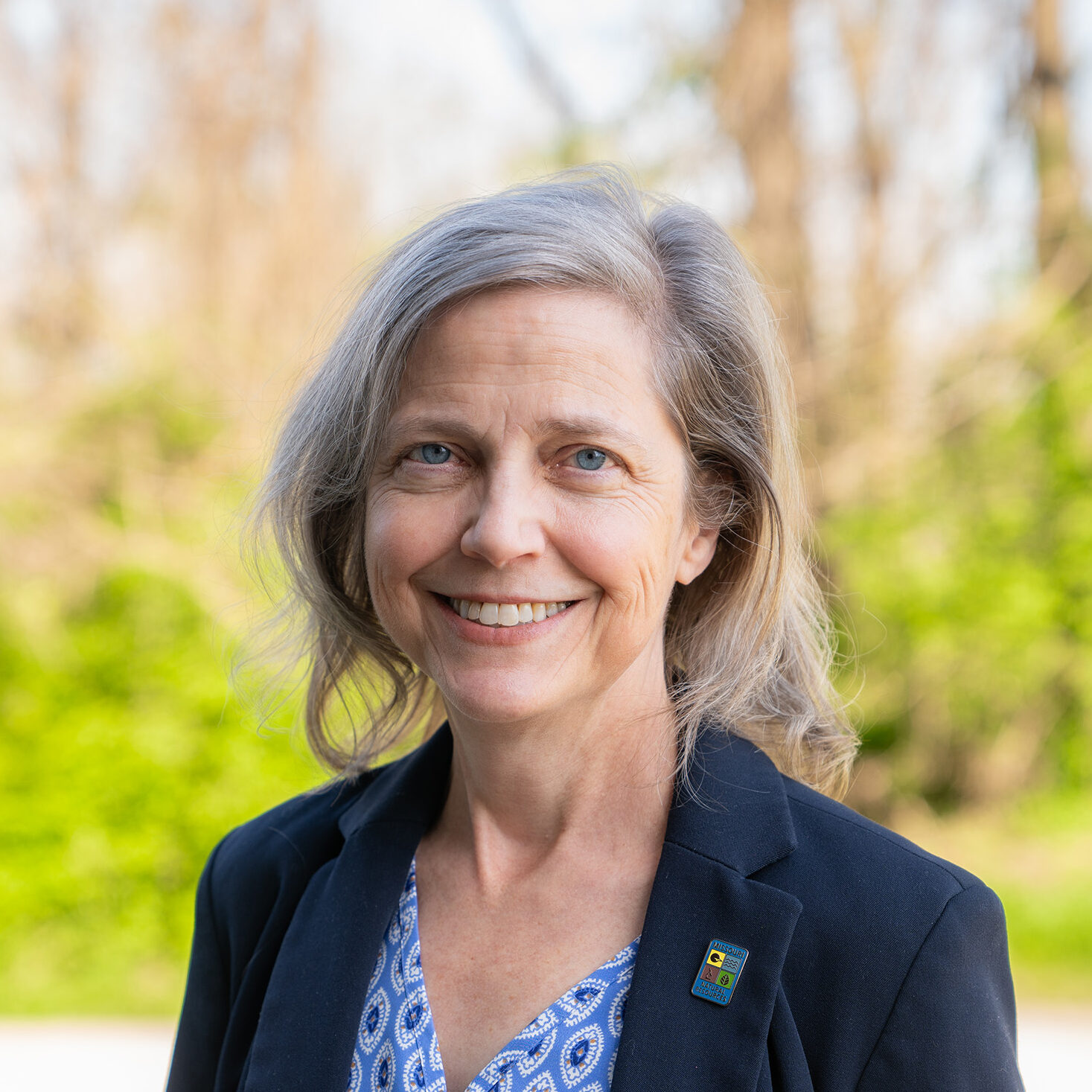
MoDNR Deputy Director Kyra Moore previously worked as an engineer within the Division of Environmental Quality. “Early on in my career as a permit writer, I was involved in the permitting for the construction of the largest cement kiln in Missouri,” Moore said. “I enjoyed working with the industry and the citizens to ensure the facility received a permit that was in compliance with laws and regulations, but still was able to bring business to the state.”
In recent years, Moore’s leadership role has meant a shift in how she uses her engineering experience. “I deal less with technical details at this point in my career, but having a technical background helps in communicating with our technical team members.”
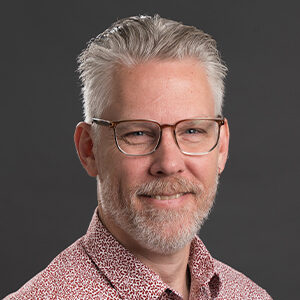
Another MoDNR leader with an engineering background is Emily Wilbur, director of the Division of Energy. “Engineers are problem solvers by practice,” Wilbur said. “Many of the issues the department faces are not well defined and have many possible solutions. Engineers help parse through the options and organize the solutions to inform a decision.”
The size and scope of the department’s numerous and ongoing environmental engineering projects can be staggering. A single project can require thousands of work hours or hundreds of millions of dollars.
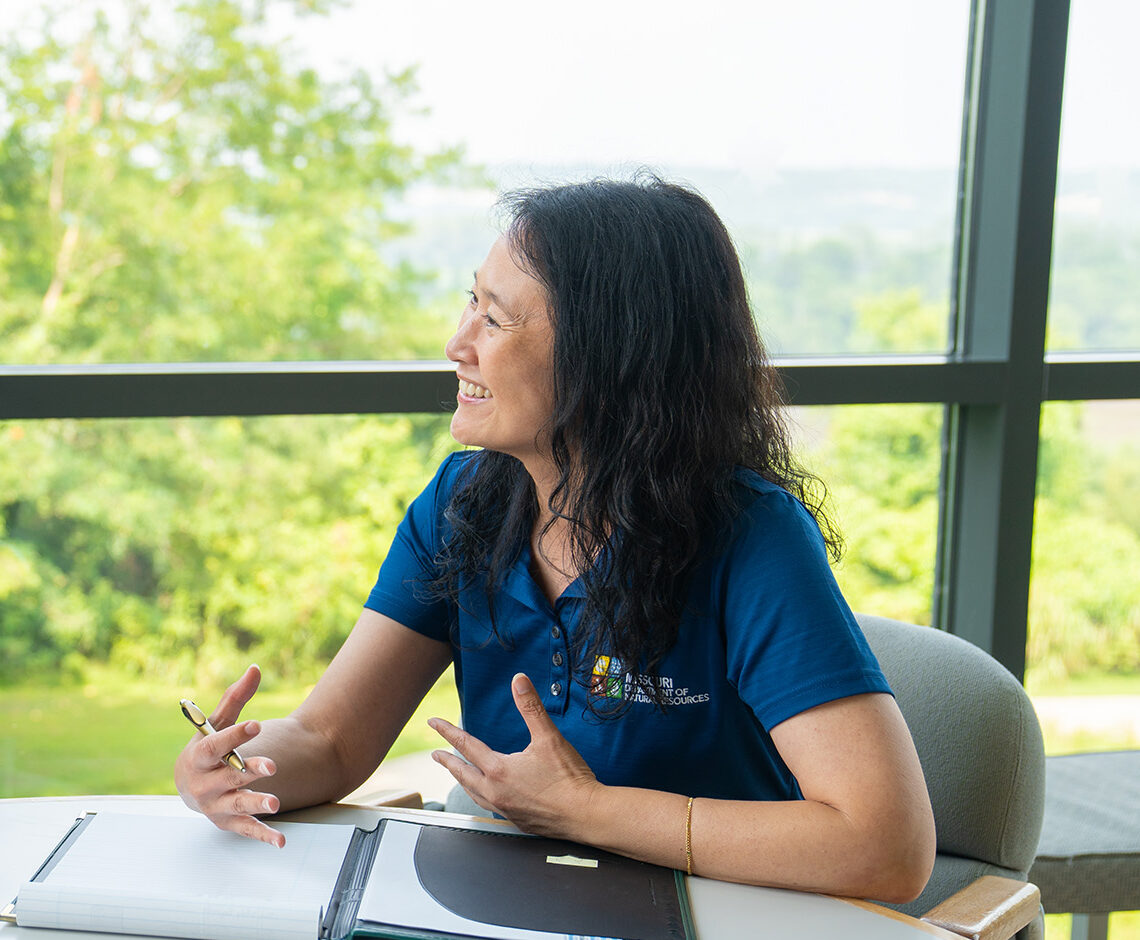
“The greatest challenge I have experienced since being at MoDNR is determining how to improve the capability and capacity of the program I manage,” said Bruns. “We are in the middle of a substantial period of capital improvement, both in terms of capital investment and number of projects. Our current budget is over $230 million, with just shy of 200 active projects. This is unprecedented in the history of Missouri State Parks. The Planning and Development Program is working hard, every day, to deliver on this challenge with excellence.”
As one might expect, commitment to public service is a common value shared by each of these highly skilled engineers.
“Throughout my career in public service, I’ve always tried to solve problems,” Fitzgibbons said. “I think I’ve done a good job at that.”
If you are interested in joining the Missouri Department of Natural Resources team, visit dnr.mo.gov/careers.