
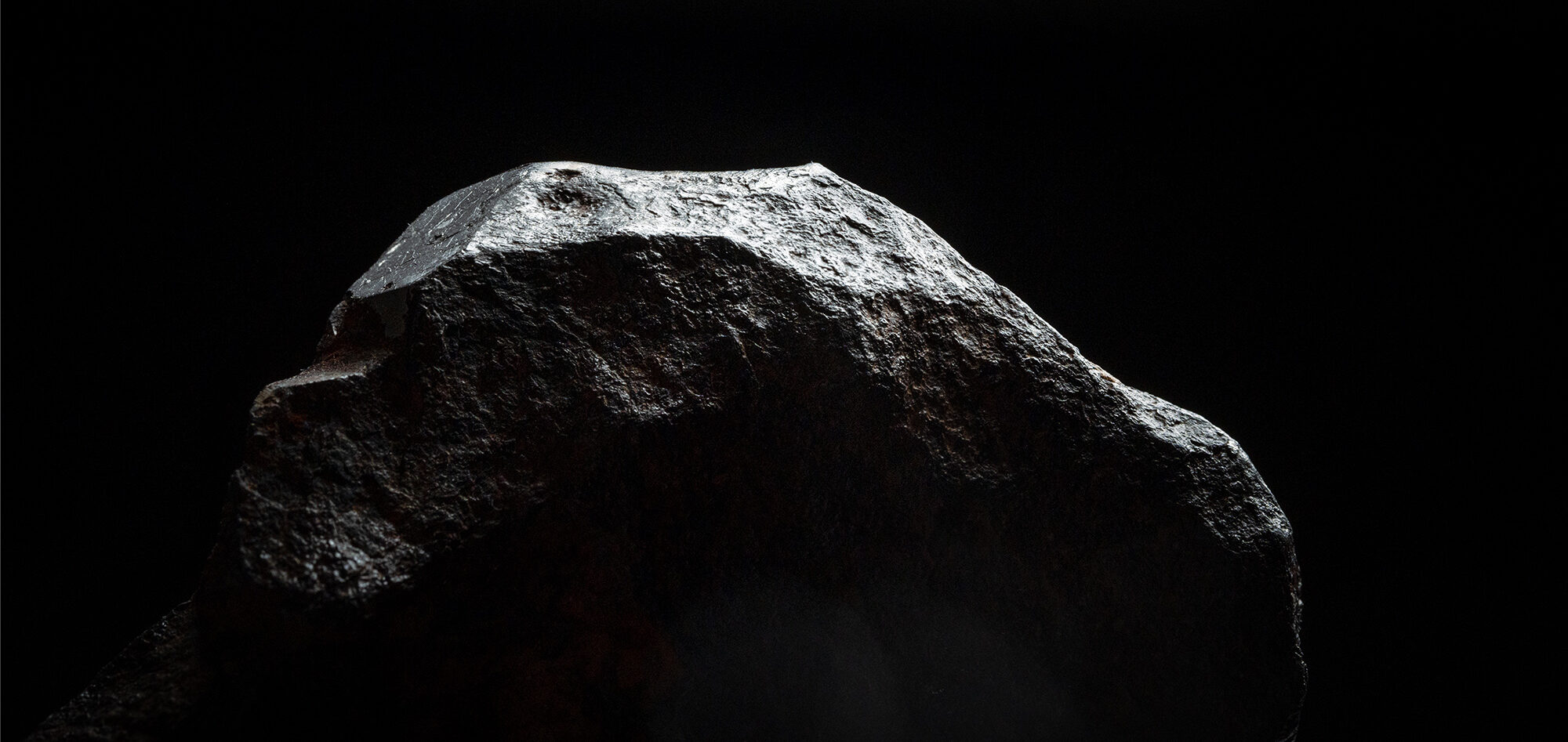
The fusion crust is the thin, shiny layer on the outside of a meteorite that forms as it falls through Earth’s atmosphere.
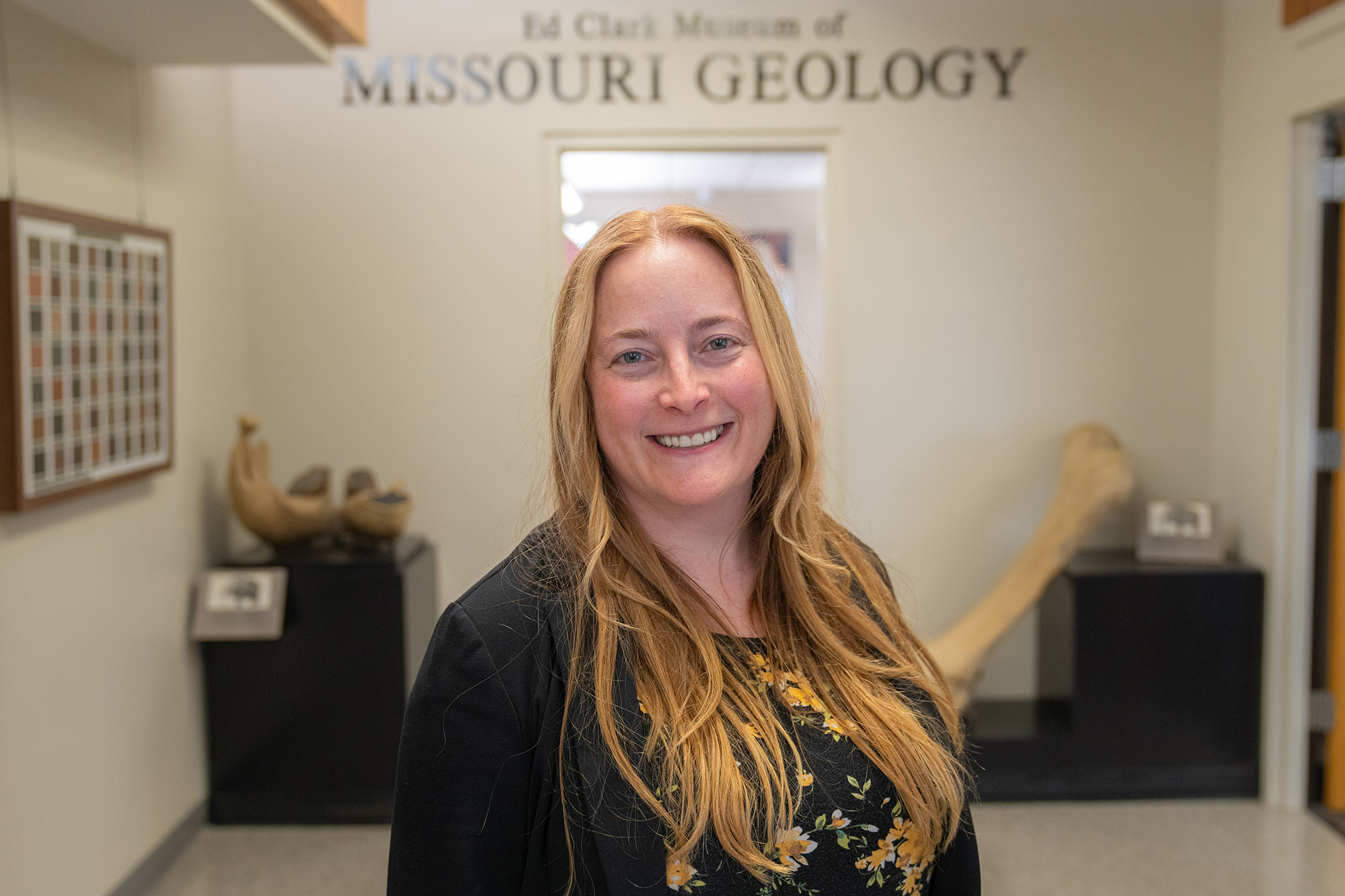
Have you ever been charmed by the glint of an unknown rock? Does learning about its true origin intrigue you? The Missouri Geological Survey has been providing such answers as part of its mission since 1853. Residents from across the state often present their discoveries to MGS geologists so they can solve the mysteries of what they’ve found.
“The Missouri Geological Survey provides the free service of identifying rocks, minerals and fossils found by the public in Missouri or elsewhere,” said Carey Bridges, state geologist and director of the Missouri Geological Survey. “Since our founding, our geologists have identified thousands of rocks, collectively weighing many tons.”
While cleaning out his father’s barn in October 2024 in preparation for a yard sale, Barry County’s Luke Linxwiler became curious about one peculiar rock he found hidden within a hay pile.
“I was raking, and I hit something hard,” Linxwiler said. “Usually, I’ll pick the rock up and toss it out of the way, but as soon as I picked it up, I was like, ‘Wait a second.’ The more I looked at it, I was like, ‘This has got to be a meteorite.’”

A welder by trade, Linxwiler recognized the weight and density of the rock as iron. A magnet also stuck firmly to it. The rock’s appearance further looked burnt, with a dark coating concealing a shiny interior.
“It looked melted and lapped over,” Linxwiler said. “When you take an acetylene torch to metal, it’ll blow [on] it [as it melts], and to me it looked like it had lapped over itself several times, like what I imagine happens when a meteorite enters Earth’s atmosphere from outer space.”
Friends told Linxwiler he was imagining things and his rock was likely just a piece of slag or mining byproduct. Nonetheless, he remained curious and wanted to obtain a professional authentication. An internet search told him the Missouri Geological Survey would do so for free.
“One of the most common inquiries we receive is from people finding a rock they assume is a meteorite. The truth is, finding a meteorite is extremely rare,” Bridges said. “Identifying a meteorite takes a lot of education, tools and most of all, years of hands-on experience examining specimens.”
An X-ray fluorescence analysis of Linxwiler’s rock at the MGS Rock Lab in Rolla showed iron, nickel and cobalt as its dominant chemical elements. That combination has only been observed in meteorites. Next, the lab applied an alcohol and nitric acid mixture to a ground and polished section of the rock to reveal another clue.
“In this meteorite’s case, discovering Widmanstätten Figures was a key piece of evidence that this was an octahedrite iron meteorite,” Bridges said. “Widmanstätten Figures are unique crystal structures that have only been observed in metallic meteorites. They cannot be faked because they require millions of years to develop in the slowly cooling cores of protoplanets or planets that once existed in the asteroid belt.
“When MGS geologists observed the Widmanstätten Figures, it confirmed that what they were holding did indeed come from outer space. A good example of Widmanstätten Figures can be seen in the Licking Meteorite, identified by the Missouri Geology Survey in 2015. A sample of the meteorite showing this unique pattern is on display at MGS’s Ed Clark Museum of Missouri Geology in Rolla.”
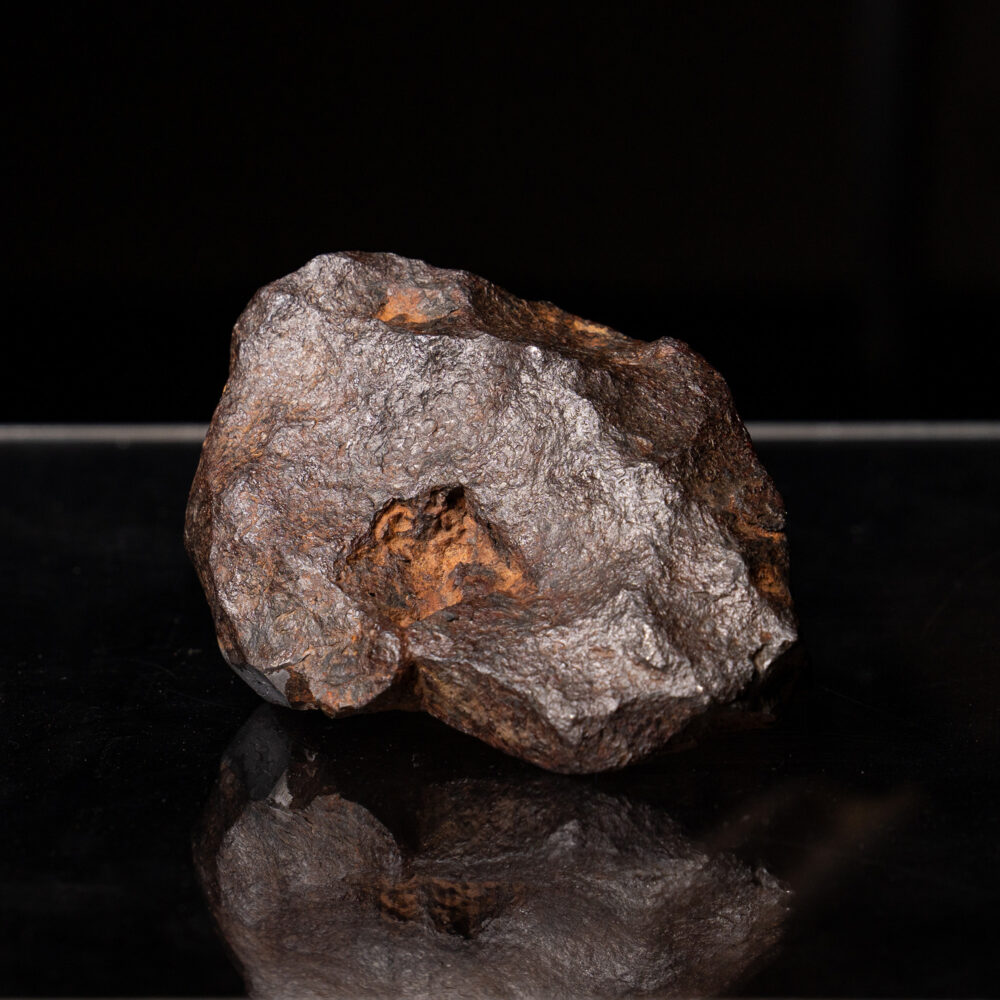


Many people’s first question is, “Was there a hole in the barn roof?” Although Linxwiler’s meteorite is certainly not from Earth, it likely didn’t land in Missouri. No hole was observed in the barn where it was found. Missouri Geological Survey geologists determined it was most likely a Canyon Diablo meteorite originating from Arizona. Linxwiler said the previous owners of his father’s property were well-traveled and likely brought the rock back from a vacation, only for it to be misplaced and forgotten within the barn.
“Half of me wants to keep it forever,” Linxwiler said. “However, I am trying to run a business, and I’ve got bills to pay. In the end, it’s just sitting there so, long-term, I’ll probably sell it. But, it’ll be hard to get rid of it.”
Bridges concluded, “In MGS’s history, only three times has the public brought us a rock identified as a meteorite. The first time was in the 1930s, the second was in 2015 and now, the third in 2024. We’re always happy to examine and run tests on rocks, minerals and fossils to determine their identity.”
The Missouri Geological Survey is a division of the Missouri Department of Natural Resources. If you have a rock you would like us to identify, stop by the division’s office in Rolla or send an email to our geologists.